


Moving a store from WooCommerce to Shopify is mostly a data problem, and data moves cleanly. URLs don't. WooCommerce builds addresses from WordPress permalinks you set years ago; Shopify rebuilds them to a fixed shape. Every address that changes is a redirect you have to create, or a 404 you hand to Google.
This guide covers how to migrate without losing search rankings: how the two platforms structure URLs, how to redirect the old ones, and how to find the URLs a standard redirect export leaves out.
Why URL Redirects Matter in a WooCommerce to Shopify Migration
Shopify and WooCommerce handle URLs differently. If a customer clicks an old WooCommerce link (from Google, a social media post, a blog, or an email), and there's no redirect in place, they'll land on a 404 page, which is bad for SEO and worse for conversions.
A proper WooCommerce to Shopify redirect strategy helps you:
- Preserve SEO rankings
- Avoid traffic loss
- Improve the post-migration customer experience
- Reduce bounce rates
WooCommerce vs. Shopify URL Structure
Let’s compare how these platforms format URLs:
Shopify uses a fixed format, while WooCommerce, which is built on WordPress, allows flexible permalink settings. This difference is why 301 redirects are essential when migrating from WooCommerce to Shopify.
The URLs Search Console won't show you
Search Console's list of broken URLs exports a maximum of 1,000 rows. On a store with more than a thousand products, that is the first page of the problem, not the whole of it, and the URLs left out are often the ones that used to rank.
Redirect Ninja reads your Search Console history through a read-only connection, ranks every broken URL by what it used to earn, and suggests the live page each one should point to. You see the traffic each dead URL was carrying before it broke, which is what tells you which redirects actually matter.
Finding the URLs Search Console won't export →
Step 1: Export Your WooCommerce URLs
Before you can start redirecting, you need a complete list of your current URLs. There are a few ways to get this:
- Check your sitemap: Usually at /sitemap.xml or via a plugin like Yoast SEO
- Use an export plugin: Many WooCommerce SEO tools offer URL exports
- Crawl the site: Tools like Screaming Frog can extract all your indexed pages
Tip: Organize URLs by type (products, categories, blog posts) to simplify your mapping strategy.
Step 2: Map WooCommerce URLs to Shopify Equivalents
Once you’ve got your list, pair each WooCommerce URL with the matching Shopify version.
Manual mapping:
- Create a spreadsheet with two columns:
Redirect FromandRedirect To - Match URLs like
/product/red-t-shirt/→/products/red-t-shirt - Upload as a CSV in Shopify or use an app to handle bulk redirects

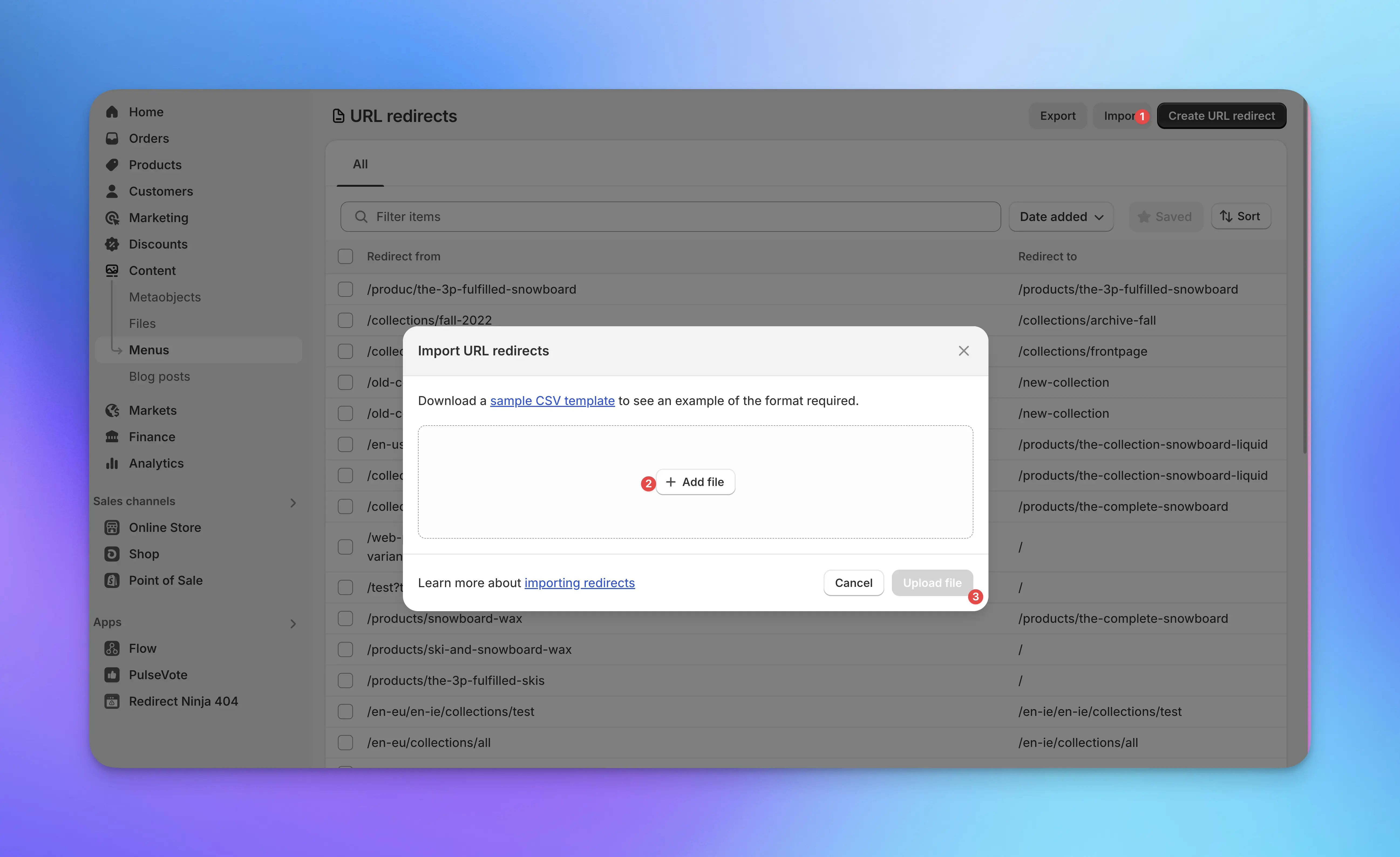
This works for smaller stores, but it becomes tedious and error-prone as your product catalog grows.
Speed Up with Wildcard Redirects
If your WooCommerce site follows predictable URL patterns, wildcard rules can simplify the job.
Example:
Redirect From: /product/*
Redirect To:   /products/*
Covers every product on your site without manually mapping each one.
Redirect Ninja supports wildcard redirects. Learn more in our Wildcard Redirects Guide.
Introducing Kevin: AI-Powered Redirects for Shopify
Our AI assistant, Kevin, reads a broken URL and your store's live content, then suggests the page it should point to. You approve the suggestion or skip it, and every approved match becomes a real 301. Above a confidence threshold you set, matches apply themselves.
It is built for the point a migration leaves behind: inconsistent URL patterns, and the broken links that only surface after launch.
Try Redirect Ninja on the Shopify App Store
SEO checklist for a WooCommerce to Shopify move
- Set up 301 redirects before you go live, not after.
- Prioritise the URLs that used to carry traffic: read Search Console and analytics history, not just the current sitemap.
- Submit the Shopify sitemap in Search Console once the store is live.
- Watch for broken links after launch; the ones a redirect export missed often appear days or weeks later.
Frequently Asked Questions
What happens if I don't set up redirects?
Old WooCommerce URLs return 404s, Google drops the rankings those URLs held, and any traffic they carried is lost. Redirects are the part of the migration that keeps that value.
Does Shopify redirect WooCommerce URLs automatically?
No. Shopify creates URLs in a fixed structure and does not map your old WordPress ones. You have to create those redirects yourself.
ay the word if you want that ceiling higher or lower — it's one edit. Next run Monday 7am ET.
Can I use my WooCommerce sitemap to create redirects?
Yes. Your XML sitemap lists your products, pages and posts. Map each old path to its Shopify equivalent, then upload the list.
How do I find URLs that broke but never got a click?
Visitor-hit lists only record a 404 after someone clicked it. Search Console's history is the only record of a URL that used to earn traffic before it broke, which is why Redirect Ninja reads it.
Final thoughts
Before you call the migration done, check what Google still remembers.
See every WooCommerce URL that no longer resolves, and what it used to earn. Get your free damage report